DRF.
Equipment Details
Active
Thermogravimetric Analysis and Mass Spectrometry (TGA-MS)
Explore the technical specifications and detailed description of this equipment below.
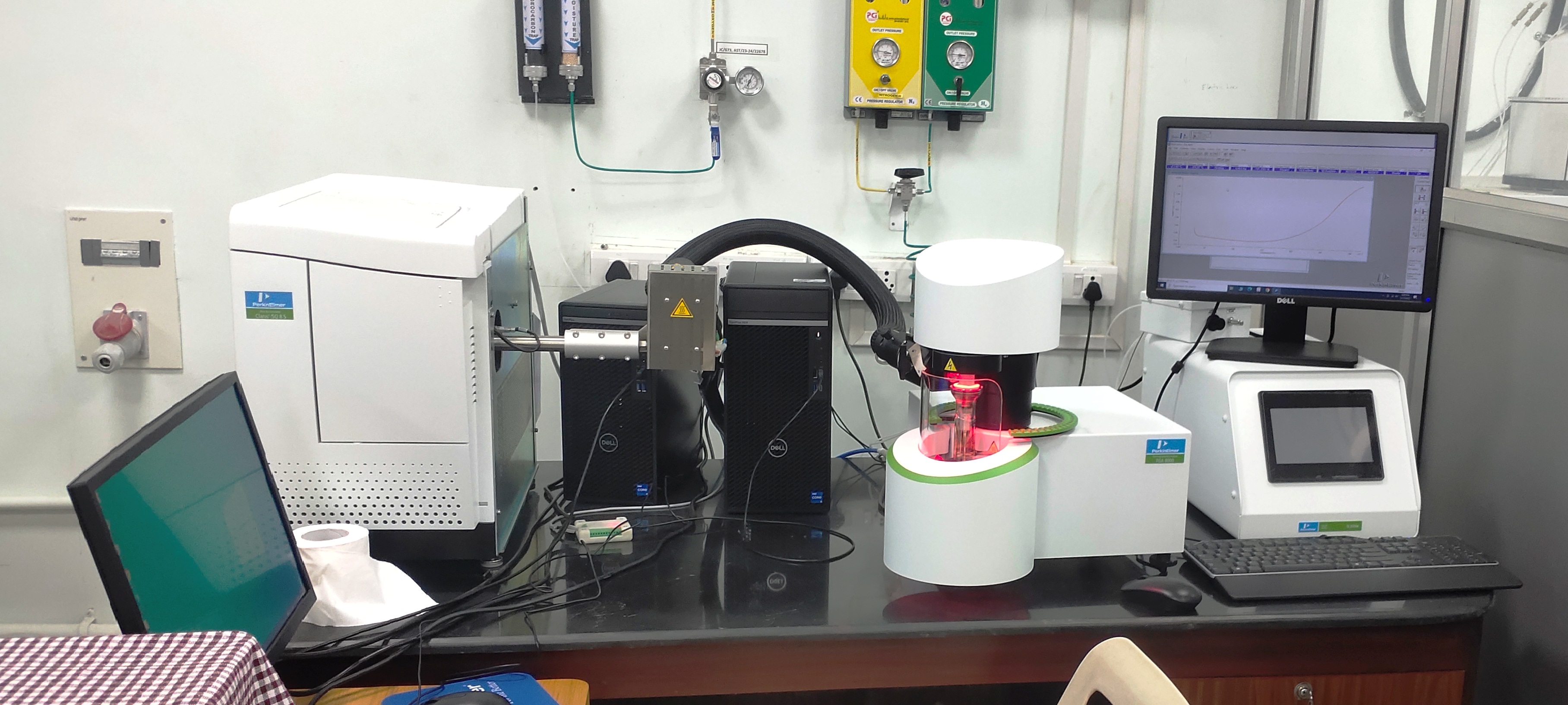
Quick Information
- Rate / Slot To be decided
- Date of Purchase Not Specified
- Custodian Name N/A
- Operator Name Mr Anup Dolai
- Official Link N/A
Description
Thermogravimetric Analysis-Mass Spectrometry (TGA-MS) Analyzer: Comprehensive Description
1. Overview:
The Thermogravimetric Analysis-Mass Spectrometry (TGA-MS) Analyzer is an advanced hyphenated analytical instrument that combines Thermogravimetric Analysis (TGA) with Mass Spectrometry (MS) to study the thermal decomposition and evolved gas composition of materials. This system provides simultaneous measurement of weight loss (TGA) and gas-phase analysis (MS), offering valuable insights into material stability, decomposition mechanisms, and volatile byproducts.
2. Key Components:
A TGA-MS system consists of two main modules:
2.1 Thermogravimetric Analyzer (TGA):
- Measures changes in a sample’s mass as a function of temperature or time in a controlled atmosphere (inert, oxidizing, or reducing).
- Key Features:
- High-precision microbalance (±0.1 µg sensitivity).
- Programmable temperature range (ambient to 1200°C).
- Controlled gas flow (N₂, O₂, He, etc.).
- Multiple heating rates (isothermal, dynamic, modulated).
2.2 Mass Spectrometer (MS):
- Detects and identifies gaseous species evolved during thermal decomposition.
- Common MS Types Used:
- Quadrupole MS: Fast scanning, good sensitivity, moderate resolution.
- Key Features:
- Real-time monitoring of evolved gases (H₂O, CO₂, CO, hydrocarbons, etc.)
- Detection limits in the ppm to ppb range.
- Electron Ionization (EI) mode.
2.3 Interface Between TGA and MS:
- A heated transfer line prevents gas condensation.
- Capillary or jet separator for efficient gas transfer.
- May include a gas dilution system for high-concentration samples.
3. Working Principle :
1. Sample Loading: A small sample (typically 5–15 mg) is placed in a ceramic crucible inside the TGA furnace.
2. Temperature Program: The sample is heated under controlled conditions (ramp, isotherm, etc.).
3. Mass Loss Measurement (TGA): The microbalance records weight changes as the sample decomposes.
4. Gas Evolution (MS): Volatilized gases are transferred to the MS via a heated transfer line.
5. Mass Spectral Analysis: The MS ionizes and detects gas molecules, providing mass-to-charge (m/z) ratios for identification.
4. Advantages of TGA-MS:
✔ Simultaneous Data: Combines weight loss and gas analysis in a single experiment.
✔ High Sensitivity: Detects trace-level evolved gases.
✔ Versatile: Works with solids and powders.
✔ Quantitative & Qualitative: Provides both mass loss curves and gas identification.
5. Limitations:
✖ Complex Data Interpretation: Requires expertise in both TGA and MS.
✖ Overlapping Peaks: Some gases may have similar m/z ratios.
✖ Sample Limitation: Don't Works with liquid samples and that are explosive or toxic samples.
Technical Specifications
The TGA-MS Analyzer is a hyphenated analytical system integrating Thermogravimetric Analysis (TGA) and Mass Spectrometry (MS) for simultaneous measurement of sample mass loss and evolved gas analysis. It is used for material characterization, decomposition studies, and thermal stability assessments.
Parameter Specification
Temperature Range → Ambient to 1200°C
Cooling Rate → Controlled cooling (e.g., 50°C/min with forced air)
Balance Sensitivity → 0.1 µg (microbalance resolution)
Sample Mass → 5 – 15 mg for best accuracy
Atmosphere Control → Inert (N₂, He), Oxidizing (O₂, air),
Gas Flow Rates → 10–200 mL/min (adjustable)
Crucible Types → Ceramic
Parameter Specification
Temperature Range → Ambient to 1200°C
Cooling Rate → Controlled cooling (e.g., 50°C/min with forced air)
Balance Sensitivity → 0.1 µg (microbalance resolution)
Sample Mass → 5 – 15 mg for best accuracy
Atmosphere Control → Inert (N₂, He), Oxidizing (O₂, air),
Gas Flow Rates → 10–200 mL/min (adjustable)
Crucible Types → Ceramic